Merrowed vs. hot-cut: choosing a patch border
Merrowed borders are thick, wrapped edges for round, square and shield patches; hot-cut edges follow any shape. How they differ and which one to pick.
· 3 min read
Key takeaways
- A merrowed border is a thick, raised edge of thread wrapped around the patch by an overlock machine. It gives the classic badge look and only works on simple outlines: circles, squares, rectangles and shields.
- A hot-cut edge is cut with a laser or heated blade that seals the fabric, so the patch can follow any outline — letters, animals, logos, stars.
- Both are durable. A merrowed border hides the fabric edge completely; a hot-cut edge is usually finished with a satin-stitch outline so it doesn't fray.
- Rule of thumb: pick merrowed for a classic round or shield badge, and hot-cut for a custom shape or a cleaner, modern look.
The border is the first thing people notice about a patch. It frames the design, sets the style, and decides which shapes are possible. There are two main options, and choosing between them takes about a minute once you know how each one is made.
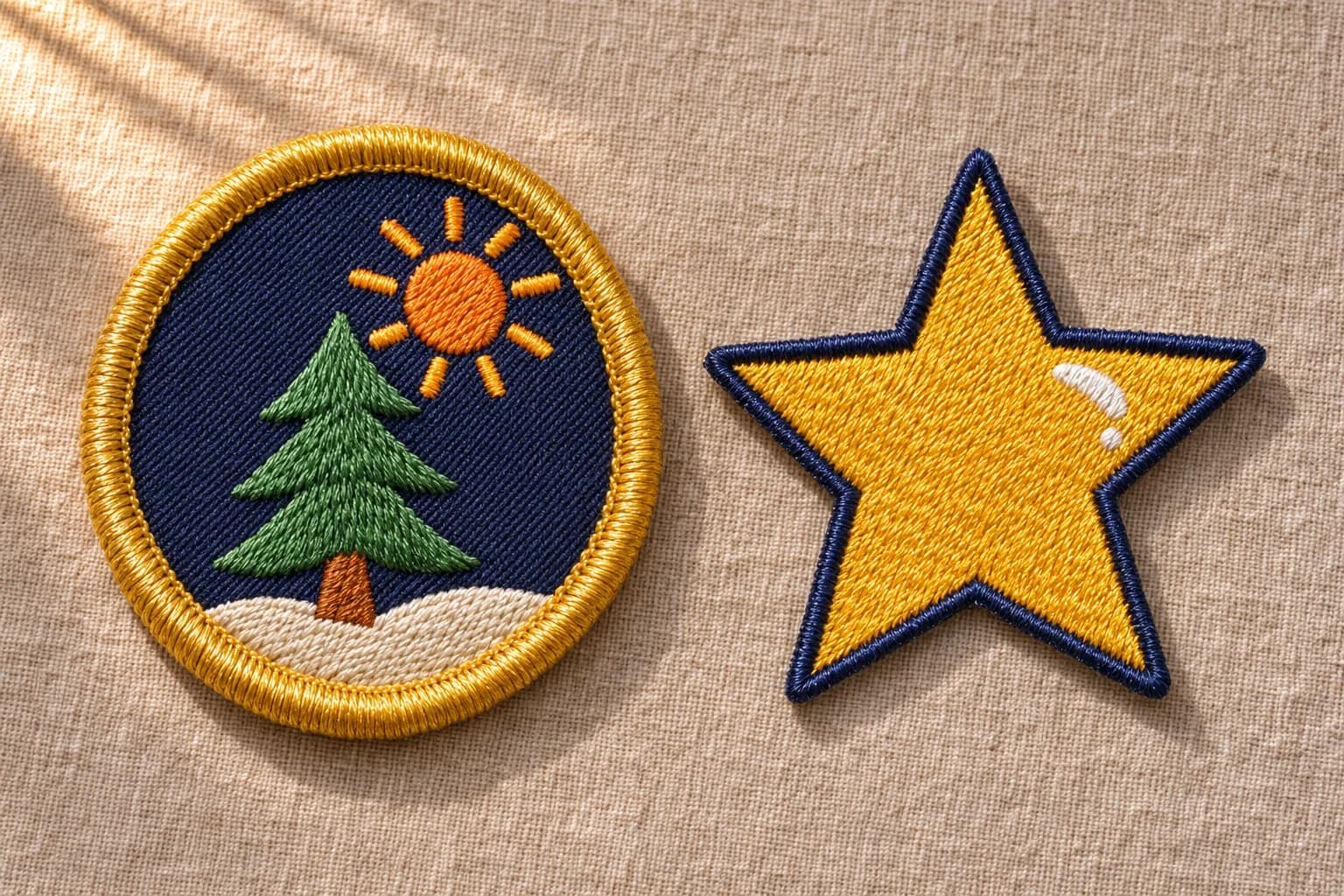
What is a merrowed border?
A merrowed border is made after the design is stitched. An overlock (merrow) machine wraps thread tightly around the outside edge of the patch, building a rounded, raised rim about 3–5 mm wide. It's the border you see on scout badges, fire department patches and classic club emblems.
- Look: thick, raised, traditional.
- Shapes: circles, ovals, squares, rectangles and shields — outlines without sharp inside corners.
- Durability: excellent. The fabric edge is fully covered, so it can't fray.
What is a hot-cut edge?
With a hot-cut edge, the patch is cut from the embroidered fabric by a laser or a heated blade. The heat melts and seals the threads at the cut, so the edge stays clean. Most hot-cut patches also get a narrow satin-stitch outline sewn before cutting, which adds color and strength.
- Look: clean, flat, modern.
- Shapes: any outline — lettering, animals, mascots, logos, stars and irregular shapes.
- Durability: very good when finished with a satin-stitch outline.
Side-by-side comparison
| Merrowed border | Hot-cut edge | |
|---|---|---|
| Shapes | Circle, square, rectangle, shield | Any shape |
| Edge look | Thick, raised, rounded | Thin and flat |
| Style | Classic badge | Clean, modern |
| Fraying | Edge fully wrapped | Sealed by heat, usually outlined |
| Best for | Clubs, teams, uniforms | Logos, mascots, lettering |
How to choose
- Start with the shape. If your design has a custom outline — a logo silhouette, an animal, a word — choose hot-cut.
- If the shape is a circle, square, rectangle or shield, decide on the look: merrowed for a classic badge, hot-cut for a slimmer, modern edge.
- Match the border color to your design. A border in your main color or in gold, navy or black usually looks best.
Not sure? Pick the shape in our price calculator — merrowed is only offered for shapes it can stitch, and your free proof shows the border before anything is made.
Frequently asked questions
Can a custom-shaped patch have a merrowed border?
Usually not. The merrow machine needs a smooth outline without sharp inside corners, so custom shapes use a hot-cut edge with a satin-stitch outline instead.
Which border lasts longer?
Both last for years on clothing and bags. A merrowed border fully covers the fabric edge; a hot-cut edge is sealed by heat and normally finished with a stitched outline.
Does the border change the backing options?
No. Iron-on, velcro (hook and loop) and sew-on backings all work with both border types.
Will I see the border before production?
Yes. Before bulk production we stitch a first sample and email you photos showing the border style and color; bulk production starts only after you approve it.
See your price in seconds
Start designing